Non-Custodial Stablecoin Checkout: Mechanics and Use Cases
Explore the mechanics of non-custodial stablecoin checkout, how USDC payments flow, and when businesses should choose self-custody payment flows for crypto transactions.

A stablecoin checkout that never holds your funds or keys is not new to crypto, but for businesses, the mechanics matter. USDC is now a standard quote currency for SaaS, B2B, and vendor payments. The choice is not if you support stablecoin payments, but how. This piece explains what a non-custodial stablecoin checkout is, with worked examples, and when it fits best for crypto businesses and their customers.
What Makes Checkout Non-Custodial?
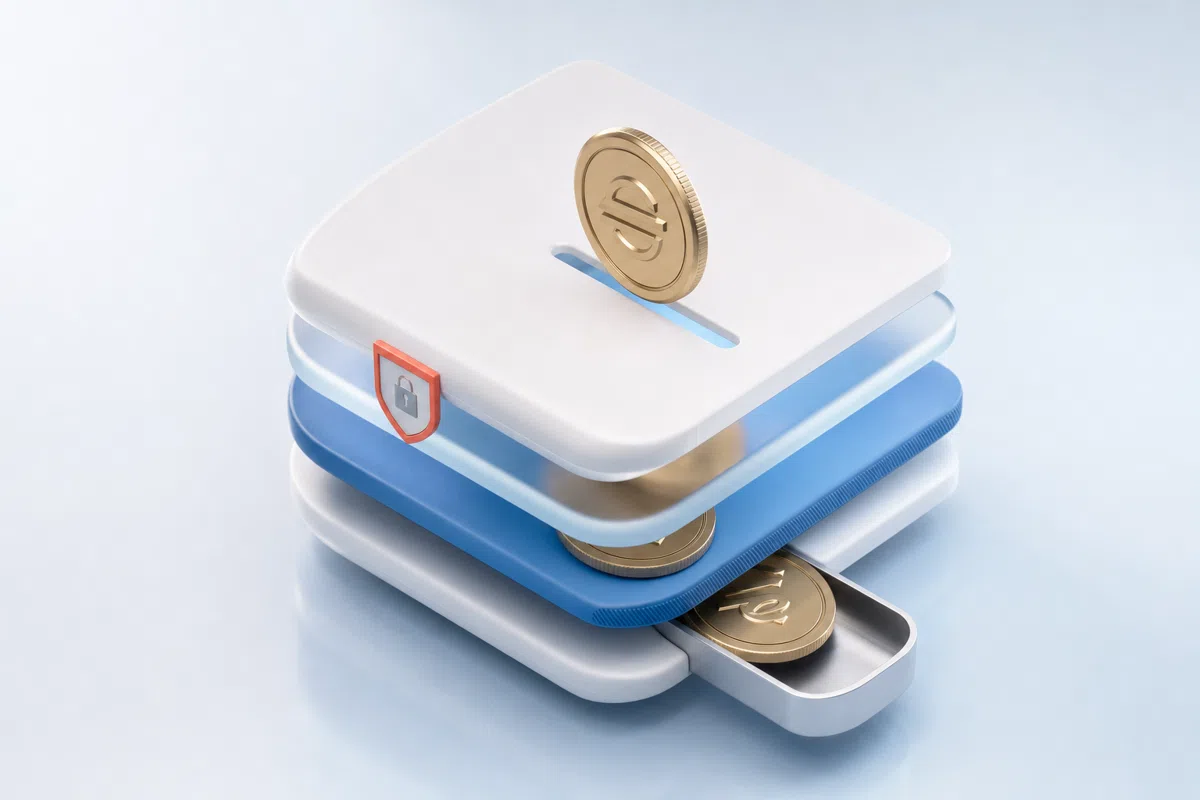
A non-custodial checkout never takes control of your funds. The user pays directly from their wallet. The merchant receives funds at an address they control. The platform that powers the checkout, such as Reclack, never sees a private key or seed phrase, and cannot move funds on behalf of either party.
This is different from platforms that request deposits into a pooled address, or hold funds in escrow. In a non-custodial flow, the platform can present an invoice, generate a payment request, and track settlement. It does not touch the money.
How Stablecoin Payments Flow in Self-Custody Checkout
The mechanics are simple. The platform prepares a payment request. The customer connects a wallet and signs a transaction. Payment moves from their wallet to the merchant’s settlement address. The transaction settles onchain. The platform then marks the invoice as paid, based on the confirmed transfer.
For recurring payments, the customer can sign a bounded approval. This creates a payment cap, a maximum amount that can be pulled in a period, such as $200 USDC per month. The platform can only initiate payments up to this cap, and only for the period specified. There is no unlimited or open-ended approval.
Why Bounded Approvals Matter
Consider a SaaS subscription billed at $50 USDC per month. At checkout, the customer sees a request to approve a $60 cap for monthly billing. They sign this cap in their wallet. If the next invoice is $50, the platform can collect it, but if an attempt is made to pull $100, the transaction fails onchain. The cap is visible and enforced at the smart contract level.
This protects both sides: the merchant cannot overcharge, and the customer’s risk is limited to the amount they approve. They can revoke or lower the cap at any time in their wallet. If they remove the approval, future collections fail cleanly. No payment can be taken beyond the signed cap.
A Worked Example: Collecting USDC for SaaS
Suppose you run a SaaS product that charges $75 USDC per month. Your customer is an engineering team paying from a Gnosis Safe on Polygon. Here’s how non-custodial checkout works:
- Your backend creates an invoice for $75 USDC, with your Polygon address as the settlement target.
- The customer gets a link. They connect their Gnosis Safe and are prompted to approve a $90 cap for recurring billing.
- The team approves this cap in the Safe, with two signers.
- On the billing date, the Reclack smart contract attempts to pull $75 USDC. The transaction is signed by the Safe, and funds move directly from the Safe to your Polygon address.
- Reclack monitors the transaction. Once confirmed, it marks the invoice as paid. No funds ever touch Reclack.
- If you later try to collect $100 USDC, the transaction fails. The cap blocks it.
The Safe team retains control throughout. They can see, adjust, or revoke the approval in the Safe UI. Your SaaS never sees a private key, and Reclack never holds their funds.
When Should You Use Non-Custodial Checkout?
When Your Customers Insist on Self-Custody
Crypto-native teams often have policies that prohibit sending funds to custodial platforms. They use multisig wallets, hardware signers, or policy-enforced wallets. Non-custodial checkout is the only practical way to collect from these wallets at scale, especially for recurring payments.
When Finality and Auditability Matter
Each payment settles onchain, directly from payer to merchant. There is a clear trail. Your finance team can verify each payment using standard block explorers. There is no risk that a platform holds, delays, or reverses funds. Once confirmed, the payment is final.
When Regulatory and Counterparty Risk Must Be Minimized
By never taking custody, the platform does not become a money transmitter. There are no pooled funds. This reduces regulatory scope and counterparty risk, for both merchant and customer. If the platform goes offline, funds are still safe and accessible.
When You Need Flexible Invoicing or Usage-Based Billing
Non-custodial checkout can be used for one-time invoices, recurring subscriptions, or usage-based billing. The same flow works for SaaS, infrastructure, consulting, and more. Caps can be adjusted to match usage patterns, and approvals can be revoked at any time.
When Non-Custodial Checkout May Not Fit
- If your customers are not comfortable with wallets or signing transactions, the flow may add friction.
- If you need fiat offramps, or automatic currency conversion, non-custodial checkout will not provide that out of the box.
- If you need chargebacks or disputes, be aware that onchain payments are final. Once settled, there is no way to reverse the transfer.
What Happens If Payment Fails?
If the wallet lacks funds, or the approval cap is too low, the attempted payment fails onchain. The platform can notify the customer and retry. There is no partial collection. No risk of overdraft or hidden fees. The customer stays in control.
How Reclack Handles Non-Custodial Stablecoin Checkout
We built Reclack to make these flows standard for crypto businesses. Our checkout supports one-time and recurring USDC collection on Base, Ethereum, and Polygon. We never touch customer or merchant funds. Every billing cap is visible and signed, and all settlement flows directly to your address. If you want to see how non-custodial stablecoin checkout fits your use case, visit Reclack for docs and live examples.